
Quite honestly, I have to say that sometimes it absolutely blows my mind when I find out what people are willing to believe. For example, the percentages in the weather on iPhone In recent weeks and months, more and more people have interpreted it as an indication of how much of a given area will rain, snow, be stormy or anything else at a given hour or day, with which percentages can be linked. However, this is of course complete nonsense and with this article I would like to clarify this issue once and for all.
You might be interested in
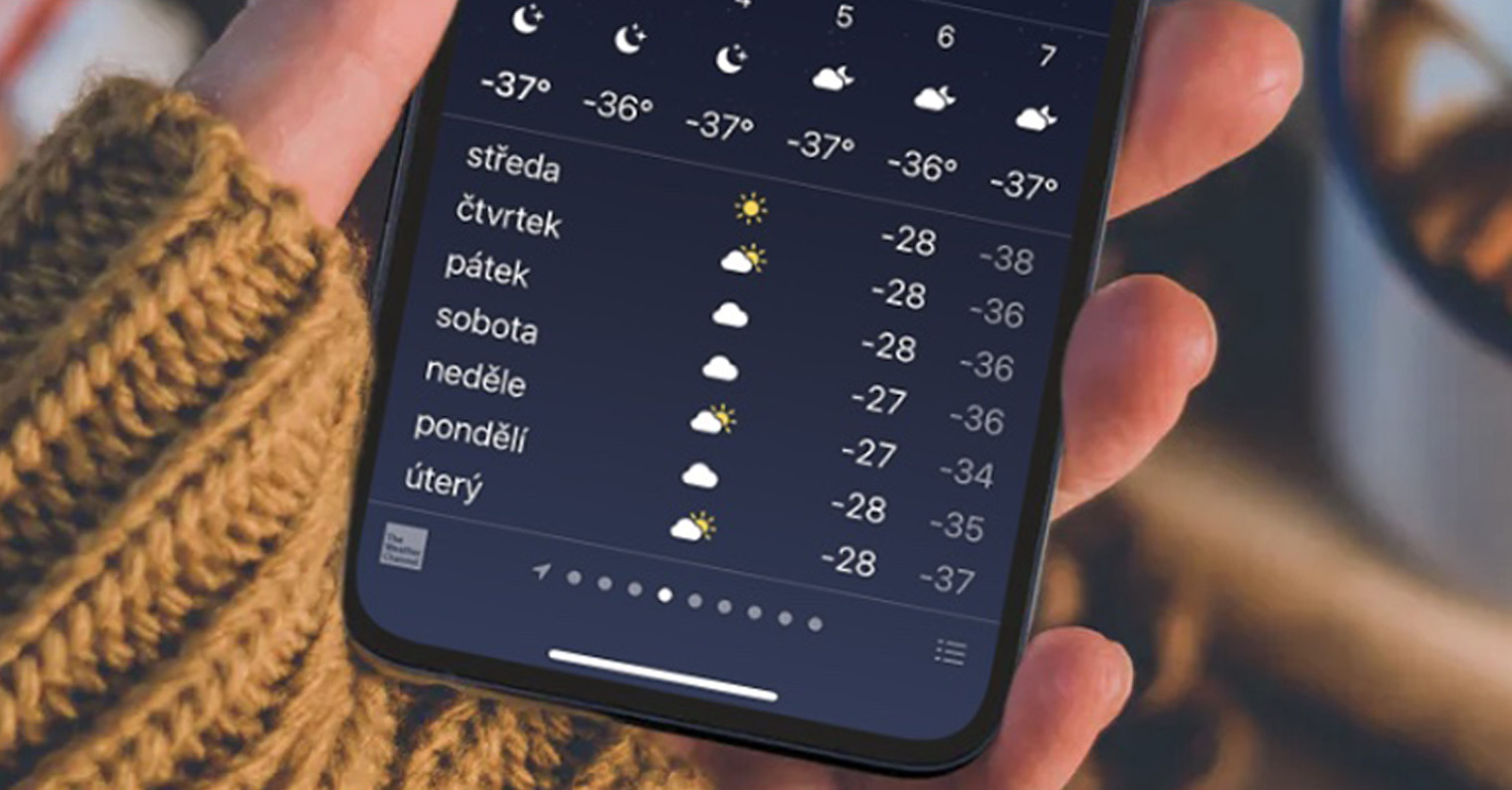
When I was looking for sources for this text, I somehow understood why some people believe the claims about the percentage of damage to a given area. On the pages Applu you will not find any literal information about what percentages mean anywhere, although I honestly think it is only because he somehow believes that this is a completely clear matter. After all, on his website he himself explains percentages "between the lines" in words about "precipitation probability", which logically cannot be expressed in any other way than percentages (or rather, some number that expresses how likely the occurrence of a given phenomenon is). Moreover, expressing the probability of precipitation in percentages is a completely standard method that you can find practically everywhere, in contrast, you would search in vain for the percentage of precipitation in a certain area. And if you wanted to Apple to issue in this direction, it would be foolish to think that he would not inform about it on his website, when it was a completely new approach to the interpretation of predictions.

There are many more arguments why it is absolutely nonsense to think that percentages in the weather show the area that a phenomenon will affect in a given area. Another one is that if even 10% appears somewhere, it ultimately means that the given phenomenon will happen. 100% probability, even if only in 10% of the given area. And predicting that it will definitely rain in 10% of Prague, while the rest of the city will be dry is, logically, much more complicated than saying that there is 10% of rain in the entire territory of Prague.ancand for rain. Apple and by extension no other operator of weather forecasting applications will take the risk of not being right with their forecast when they have the opportunity to show a more general but significantly more realistic model. In addition, think about how complicated forecasting models or weather forecasting applications would have to calculate the percentage of rain in a certain area. After all, every city is "shaped" differently, and therefore, when using this system, applications and models would probably have to calculate directly with cadastral maps so that their predictions are at least somewhat beneficial for people. For example, if only a radius of a few hundred meters in which the village was located, and it was narrow but long, the models could predict rain a few hundred meters from the village somewhere in the forest. And that doesn't really matter to anyone.
You might be interested in

In a way, when I was looking for information for this article, I was also struck by the fact that when I tried to google where the statement about the percentage of rainfall in a given area actually came from, I was unsuccessful, because practically on all at least somewhat relevant sites you will read that the percentage of weather are equal to the probability of the occurrence of the given phenomenon in general. Therefore, I attribute this whole interpretation more and more to a complete misunderstanding of the text on one of the first links that jump out at you in Google when searching for similar questions. Specifically, we are talking about an article from iDnes on the topic "Occasional showers. But where? Or how to understand the dictionary of meteorologists?", in which you can find information on what the phrases "in the whole territory", "in most of the territory", "rarely" and "without occurrence" mean in percentage terms. How can something like this be misinterpreted, you ask? Simply. Someone probably simply took this information, did not understand that it refers to the entire Czech Republic (in other words, to any other country) and began to "graft" it onto much smaller territorial units, which is complete stupidity, because these phrases are not "built on" ". Moreover, in meteorology, the phrases "on most of the territory", "occasionally" and so on are used to describe the impact of the territory, not percentages. So it is complete nonsense if he went in that direction Apple upstream and instead of "in most areas" was saying 70 percent or more in its Weather app and meant the same thing.
So, as you can see for yourself, disproving complete nonsense is not difficult at all - you just need to think a little and, if you have time, browse the Internet a little. So, the next time you see similar craziness on TikTok, Instagram, YouTube or other places, don't believe them, because it's just spreading lies by people who are either trying to get followers, or simply don't know how to think critically.




MiniI had to report an error in the weather at least 2 times recently, which did not correspond to the reality in the given location🤷🏻♂️
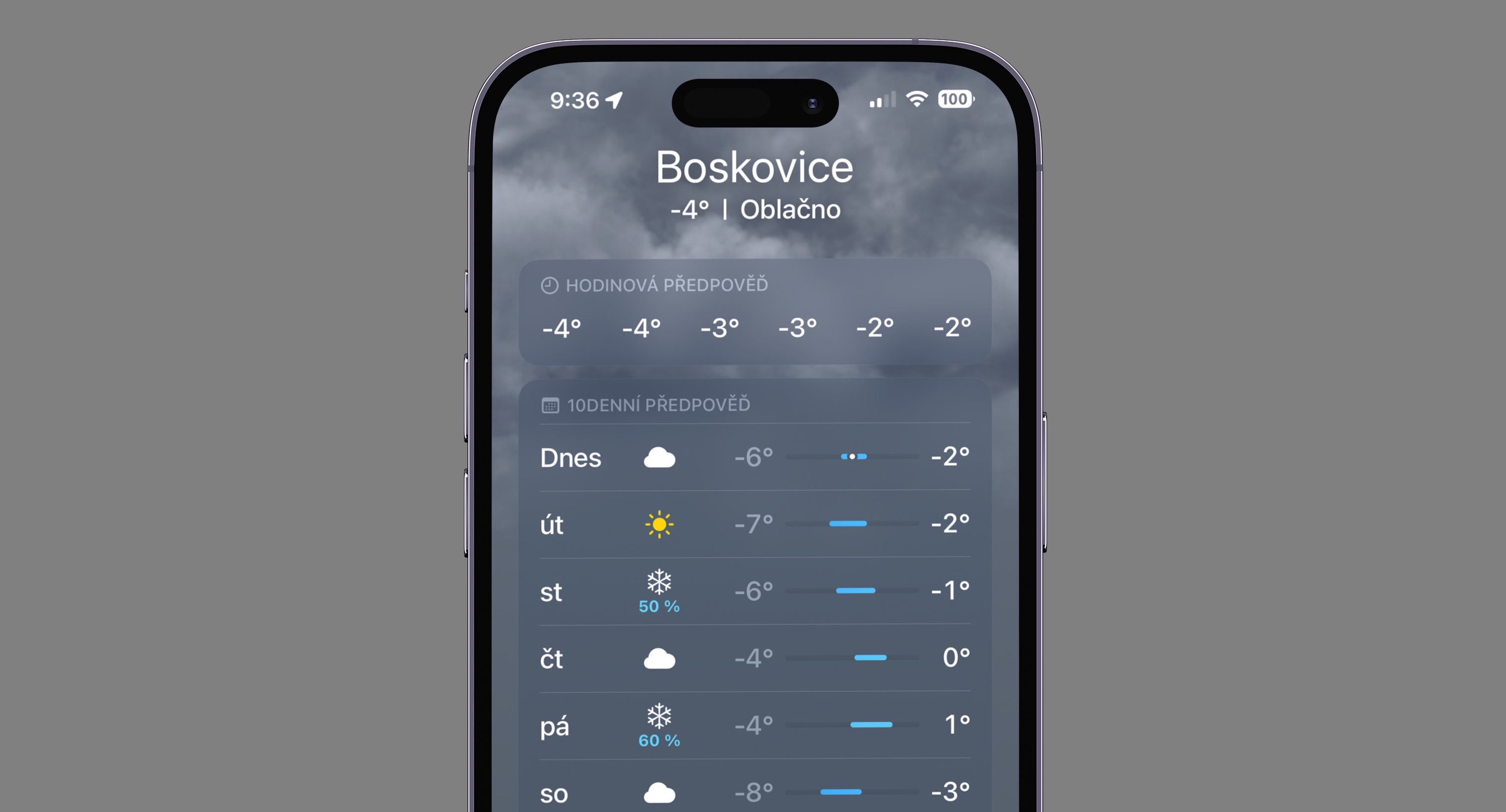
Weather on iOS is really strange. Maybe I'm weird, but it took me a long time to understand what those "blue lines" are for each day...
At the same time from iOS 16 sometimes when I launch the weather app, a new "card" or "panel" pops up first, where the weather is based on the current location (apparently when the app is hard-locked). But I have no idea what it's supposed to be, when the weather based on the location has its own little thing - does anyone know how to turn it off?
Adjust your widgete Place on my location.
What do the blue lines mean, please? 🙂. I didn't pay attention to it until I read it now.
The blue lines graphically represent the temperature range. The white dot is the current temperature.
Overall, I prefer to look at in-weather.
So I have never met a person who would understand those percentages in any other way than the probability of precipitation. But probably a different country, different manners. :-D
I do not either.
The weather is just an estimate. Sometimes they report it a few hours in advance. 100% precipitation and it's partly cloudy, other times it's clear all day and in two hours it's cloudy with rain. We're not masters of the weather.
About two months ago, a friend told me this, and she backed it up by checking it on the Internet. Now the question is which one. I didn't want to believe it, but she seemed very believable. :-)
Only Windy for the weather.
Perhaps not, it is logical that the percentages indicate the likely precipitation and not how much it will rain.
As one meteorologist said in an interview,,, we know very precisely how it was,, we know how it is now,, and what it will be like in the hour when there is normal aircraft traffic and the data from them, there are no exceptions, so we can estimate somehow. Forecasts for the day, perhaps the week, are very indicative. Nevertheless, even though we are still not masters of the weather, many people say that there is a 30% chance of rain, so they don't go for a swim and then it doesn't rain, they are pissed off...
For many years used everywhere, Yr, weather radar, Apple weather, other weather and I don't know what else, you just have to accept the given reality plus or minus and take it as a kind of probability. Sometimes it comes out more accurate, sometimes worse, but never app It's not perfect and everyone makes mistakes sometimes. Even the once-famous Yr.no had/has quite a few mistakes.