
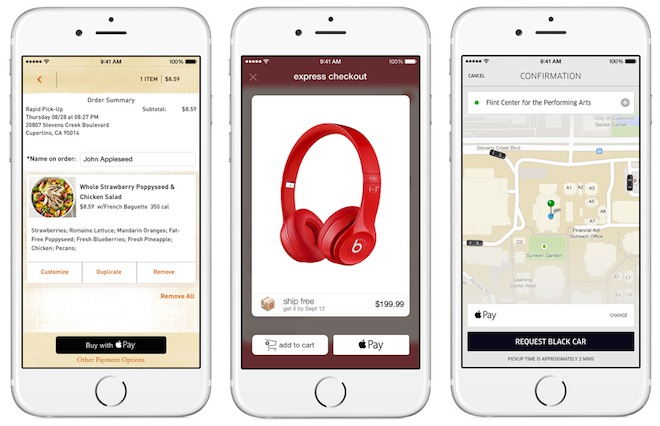
As we already know them, Apple is starting to slowly create everything that is speculated about, so we don't have to doubt too much that he wouldn't make a 12,9-inch iPad Pro. But during the last period there was also speculation about the payment system, which eventually Apple presented under the name Apple Pay. This system is actually a combination of Passbook, Touch ID a NFC technology, thanks to which users will be able to pay with the help of the phone without ever having to pull out a payment card. But everything has its limitations, and the technology will probably not reach the rest of the world until next year.
Another limitation then is that unlike NFC in other phones, the chip in iPhone is compatible only with specific payment terminals located at the company's partners Apple. But how is this system secured? Apple is the first ever company that decided to get rich NFC o EMVCo tokenization, a new security interface designed to protect emerging payment systems. According to Tom Noyes, who was an important Citigroup manager, so Apple used the most secure payment scheme on the planet. That the system works on the principle of tokenization was also confirmed earlier by Apple.
Apple Pay namely, it works with tokens that cover credit card numbers. At checkout, they generate a random 16-digit number that the seller receives instead of the actual credit card number. These randomly generated numbers cannot be deciphered back to the original credit card number. Tokens are paired with a dynamically generated single-use code that works in place of the security number on the back of the card. The code is always one-time use and is tied to only one payment. At the same time, it serves as a device identifier and, according to experts, apparently consists of encrypted token, device and transaction data. However, it should be emphasized that Apple it does not disclose anywhere how its payment system works for its security. In addition, payment security is further strengthened Touch ID, which increases the already high security. That is, even if Apple did not use Touch ID, still uses the most secure electronic payment standard ever created.






Q: How do you know it's the safest?
Q: How do you know it's not the safest? It is clear to me that it will be difficult to convince some guy, but with our collective efforts I will definitely manage it...
Peppy: Just read the article and the opinion of a person who worked at Citigroup in a rather high position...
Well, they're safe, until there's some JAnko from up and down who's willing to do it ;). Well, they simply found out where they could hide another billion, so they went for it, I'm not even surprised, given their options.
well if it will also be safe as a service icloud... no payment system is safe. This was also claimed by Fr touch Id and can also be fooled. Don't do it again Applu some supernatural company.
How did you find out that the chip in the phone is only compatible with specific payment terminals? From what I've read so far, the moment you ApplePay If the bank allows it (if it supports it), you can use your phoneoneI can pay anywhere they have a terminal with NFCThe limitation is that NFC v iPhone you cannot use it for any purpose other than payment.
Nostradamus: ApplePay doesn't have aCloud nothing to do with it. No information about the card or the transaction is entered cloudThey don't store your card details. The phone doesn't even store your card number. Security ApplePay must be compared with other existing methods of securing card transactions. If we consider the classic (NFC) a card where spending up to 500 CZK can be made without verification and otherwise you only need to know the PIN, has ApplePay on top.
dr00ster: As far as I know, yes Apple Pay it is only supported by the company's partners Apple
Jaromik Miko: yes, but I think it's more of a software issue. They don't have to change the entire cash register because of it, if it was already supporting before NFC payments.
It will be almost as safe as icloudLet's all rejoice.
I don't know what's not safe on iCloudu? Maxbasically, people use passwords like "Password1", which can be easily cracked :)