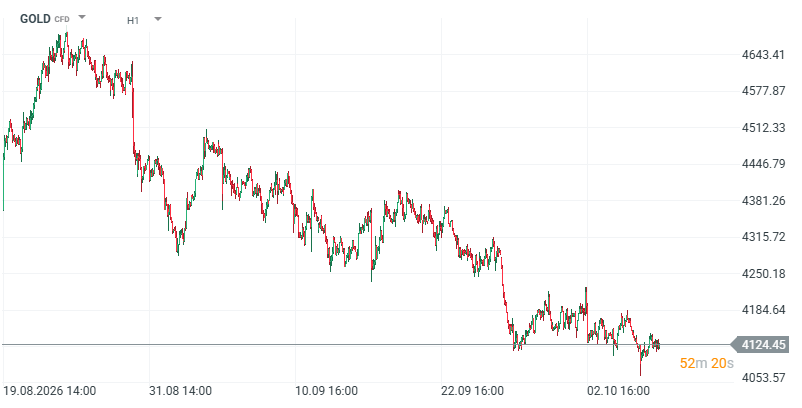
Commercial message: Gold has had an exceptionally turbulent six weeks. After a strong August rally, when its price rose by around 13% and exceeded $4,500 per ounce, there was a significant turnaround in September. The precious metal lost around 5% during the month and continued to weaken in early October. On Wednesday, October 7, its price fell to around $4,114 per ounce, its lowest level since early August. Despite ongoing geopolitical tensions, gold is unable to continue its previous growth.
Source: xStation5
US yields and stronger dollar push gold down
The main reason for the decline is the significant increase in US government bond yields and the strengthening of the dollar. The yield on 10-year US bonds has reached its highest level since 2002, which has increased the attractiveness of interest-bearing assets at the expense of gold, which pays no interest to investors. At the same time, the stronger dollar makes gold more expensive for investors using other currencies. This development is also related to the change in expectations regarding the monetary policy of the Fed, which has tightened monetary policy after renewed inflationary pressures. Although weaker September data from the US labor market reduced the likelihood of another rate hike in October, markets are still counting on a possible tightening in December.
Paradoxically, the geopolitical situation is not helping gold this time
Interestingly, gold is weakening despite the ongoing war in the Middle East, attacks on energy infrastructure and problems with oil supplies. Under normal circumstances, such events would increase the demand for safe assets. However, currently, the conflict is also making energy more expensive and renewing concerns about inflation. Investors therefore expect a longer period of higher interest rates, which puts pressure on gold. Geopolitics thus works both ways. It increases the demand for safe assets, but at the same time reduces their attractiveness through inflation and bond yields.
Central banks remain significant buyers
Gold is being supported in the long term by central banks, who continue to diversify their foreign exchange reserves. According to the World Gold Council, their net purchases of gold reached 39 tonnes in August, with China, Uzbekistan and Poland among the most important buyers. China’s central bank continued its purchases in September, for the 23rd consecutive month. Strong interest also remains among ETF investors. Global physical gold-backed funds saw inflows of around $10 billion in September, with holdings reaching a record 4,256 tonnes. This suggests that the current price weakness does not yet mean a general exodus from gold.
What do big banks expect?
Despite the current correction, many large investment banks remain optimistic about the long-term outlook. In late September, Goldman Sachs lowered its estimate for the price of gold at the end of 2026 to $4,650 per ounce, its forecast for theonec 2027, however, ponegold at $5,400. JP Morgan was even more optimistic, expecting an average price of $6,000 in the last quarter of 2026 in its June forecast. Bank of America is more cautious, expecting an average price of $4,000 for the last quarter and pointing to a possible drop to $3,750. However, it also expects a recovery in the longer term, expecting an average price of $5,000 in the second and third quarters of 2027. The different forecasts thus show that although banks mostly believe in the long-term potential of gold, short-term developments remain very uncertain.
Outlook: The Fed and bond yield developments will be decisive
In the coming weeks, the key level for gold will be $4,100 per ounce. If US yields continue to rise and the dollar remains strong, a further decline towards the psychological $4,000 level cannot be ruled out. Conversely, a stabilization in the bond market or a softening of expectations for further rate hikes could help gold recover. However, long-term factors, notably central bank purchases, geopolitical uncertainty and concerns about rising public debt, remain. The current decline therefore does not mean aonec long-term investor interest in gold.
If you are interested in trading or investing in gold, XTB has prepared a free e-book for you, How to Buy or Sell Gold at XTB , in which you will find all the necessary information about this commodity.
CFDs are complex instruments and, due to the use of leverage, come with a high risk of rapid financial loss. 77% of retail investor accounts have experienced a loss when trading CFDs with this provider. You should consider whether you understand how CFDs work and whether you can afford the high risk of losing your funds. Investing is risky. Invest responsibly.