Recognizing a real photo from an image created by artificial intelligence has become increasingly difficult in recent months. AI generators are improving at such a pace that even more experienced users often have trouble telling whether they are looking at a real image or the creation of one of the generative models. Google has therefore decided to make a tool available to the general public that can significantly help with detecting similar content. It is called SynthID Detector and its biggest advantage is that it can recognize not only content created by Google's artificial intelligence, but also by some competing tools. And what is in it for fans AppWhat is particularly interesting is that the Californian giant should soon be among the supported companies.
You might be interested in

Just upload a picture, video or audio
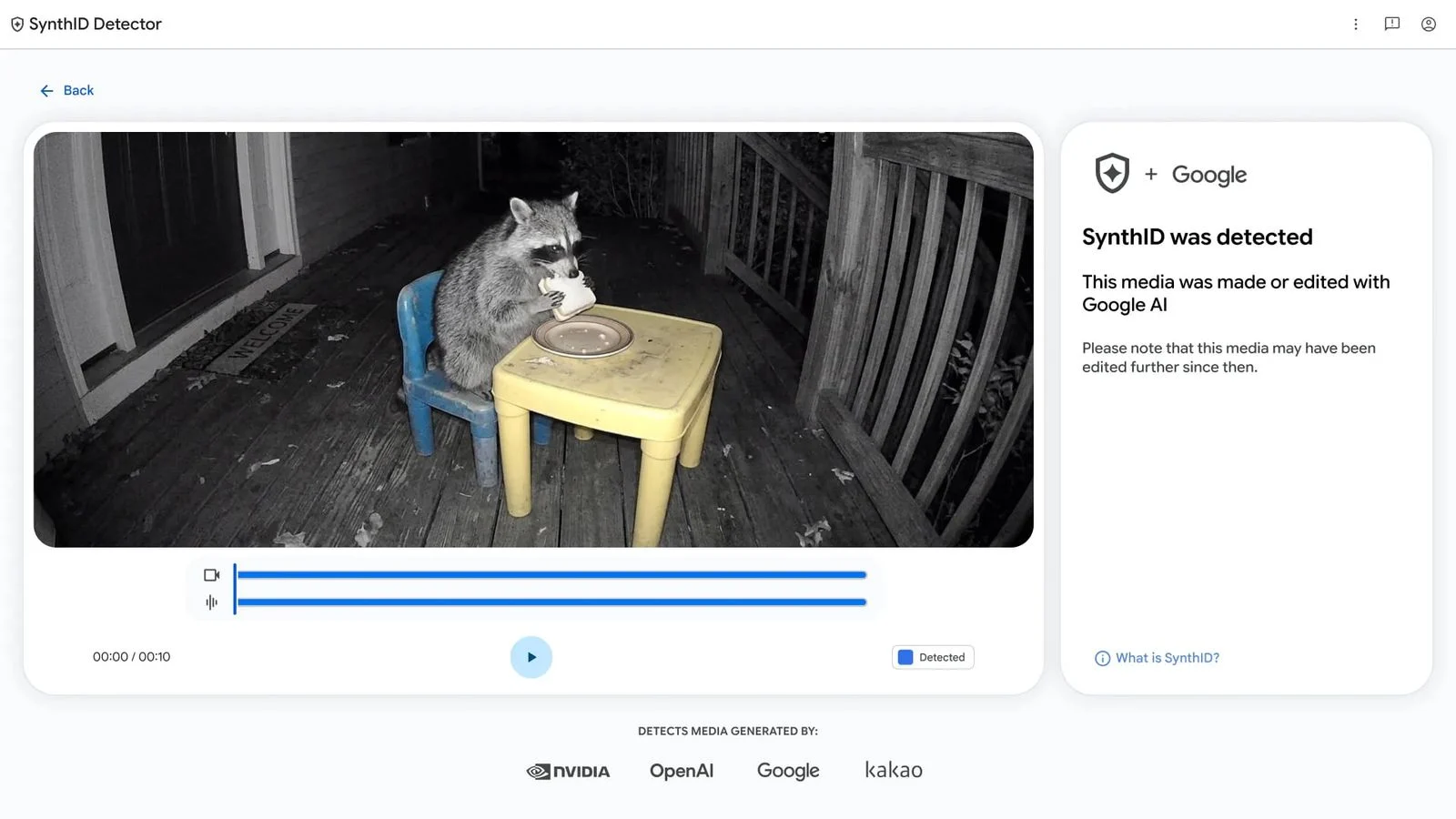
The principle of operation of SynthID Detector is quite simple. The user visits the website SynthID.com, logs in and uploads an image, video or audio file that they want to check if it was created using artificial intelligence. The tool then checks for the presence of a special digital watermark that is embedded in the content when it is created. Unlike classic watermarks, it is not visible to the human eye, so it does not distort the resulting photo or video in any way. Pro however, the verification system is recognizable.
Google introduced SynthID technology in 2023, and the detector itself began to be made available to selected journalists and other professionals last year. But now it is opening it up to all users around the world, although only in English for now. In addition to content created by Google tools, it can also recognize relevant watermarks in media originating from OpenAI, Nvidia or Kakao. In addition, support for content created using AI tools is also expected in the near future. Appyou.
But it's not a perfect AI detector
Although the new feature looks very interesting at first glance, it also has a fairly significant limitation. SynthID Detector cannot automatically recognize any image created by artificial intelligence. It only works if the file contains a compatible digital watermark. So if someone creates a fake photo using a tool that does not support SynthID technology, the detector may not detect it. Therefore, a negative result definitely does not mean that it is an authentic image.
Another limitation is that the tool cannot distinguish whether the content was completely created by AI or only edited using it. For example, if someone takes a real photo and then changes certain details in it using an AI-supported tool, the detector can also warn about the use of AI. Therefore, the result needs to be interpreted correctly. Google also requires logging in and, according to information from the Ars Technica server, expects approximately ten checks per user per day.
The numbers Google released at the time of the announcement are interesting, however. Since launching SynthID, it says it has invisibly watermarked more than 180 billion images and videos, as well as 240 years of audio recordings. Content verification is now also available through Google Search, Gemini or Chrome, where more than a million checks are carried out daily.
You might be interested in

In my opinion, it is a step in the right direction. The Internet is literally flooded with AI content, and the ability to easily verify the origin of a suspicious photo or video can be useful for almost anyone. However, it is important to remember that SynthID Detector is not a universal truth detector, but only a tool for recognizing a specific type of digital signature. Even so, it can be a very useful assistant, especially if other major technology players gradually join its support.