
One of the biggest revolutions in the history of mobile phones has been brought about by a manufacturer we wouldn't have expected. It's not the first to build a photovoltaic panel into its display. Apple or Samsung, but a manufacturer that many of you may be hearing about in the field of mobile phones for the first time. Not that I suspect some of our readers of not knowing TAG Heuer, but I believe that most people think of luxury watches rather than mobile phones when they hear this term. Tag Heuer does make phones, however, and these are phones that are modeled after Vertu or Porsche The design was valued at hundreds of thousands of crowns.
The latest model that sewscarTAG Heuer watchmakers have introduced the TAG Heuer Meridiist Infinite, a real revolution in the world of mobile phones. The phone is equipped with a photovoltaic film that is placed directly between the individual layers that make up the display. TAG Heuer calls the photovoltaic cell inserted between the layers of the display the Perpetual Power Reserve and states that it is capable of obtaining energy not only from sunlight but also from artificial lighting, for example, when you place it on a table in yourancElars.
If the label Perpetual sounds to you like a perpetual mobile, then you are not far from the truth, because the manufacturer claims that the energy generated by the cell under normal conditions is sufficient to basically never discharge the phone in standby mode. If you are using the phone, then the energy is sufficient to slowly charge the battery when it goes back to standby mode, not just to keep it at the same level.
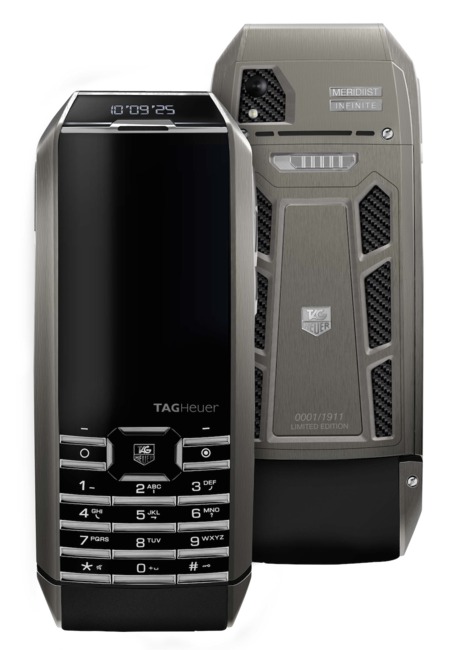
The phone is of course a luxury item and so in addition to the above-mentioned innovations, it also brings high-quality workmanship and materials used, including Titan, Kevlar, and of course the display is covered with a Applu much-commented sapphire glass. The price of this novelty has not been announced yet, but it is likely to be around 200 CZK. However, the question arises here, is the photovoltaic cell technology in the middle of the individual layers of the display a question of money or has TAG Heuer really introduced something that other companies do not yet have? Could this technology also appear in a phone like the iPhone, whose price is more than 10 times lower than that of Tag Heuer? These are questions that only the future will answer.







Well, I'm curious, this really resembles a miracle. The energy of the light falling on such a small area is pitifully small, the efficiency of salt cells is poor, the consumption of the mobile phone is high...
How do they want to put it together?
The catch will be that without charging, only the display in the cell of the mobile will work :)
I guess from the photos.
I think I won't be far from the fall, but I like to be surprised.
well, if it's not a cheap marketing trick and it really works as we all wish.. it will be a big WOW :) fingers crossed
Let's try to count.
iPhone The 5S has a stated standby time (mobile part on, no apps running, no notifications, display off) of 250 hours. The battery has 1,56 Ah at 3,7 V, i.e. 5,772 Wh. We divide this by the number of hours in standby mode and get a consumption of 0,023 W per hour. If we consider that the photopanel on the display with a size of approx. 4,7″, while the phone will be a bit bigger, say 5″, will give us 1 W at the peak, so realistically 0,05 W will not be a problem. And this will not only keep the phone alive, but gradually - slowly, slowly - it will also recharge.
peter.nr: under what conditions does the photopanel have such performance? In direct sunlight or even on a table inside the house? Are we going to fool around with our cellphones like we do with sunflowers? Especially in your pocket and it won't charge at night.
I think such a battery can slow down the discharge, but that's about it.
It seems like a good feature for an outdoor armored phone, but it sucks for this piece of jewelry.