
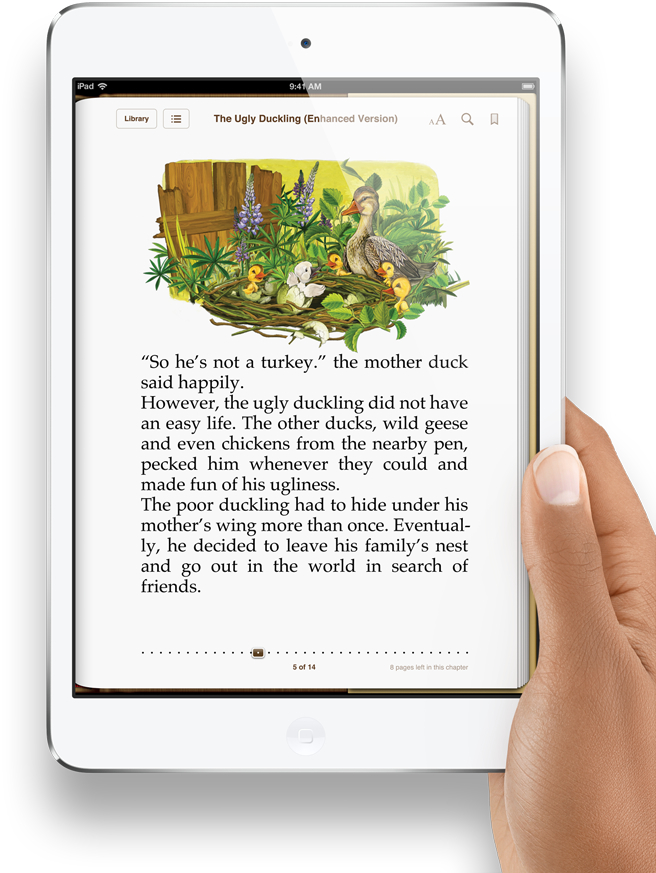
When Apple introduced the first iPad tablet, it was clear to everyone that the edges around the display were there so that you could hold the iPad and work on it at the same time. However, a few years have passed since the first iPad, and technology development is moving inexorably forward. A technology called Thumb Rejection is behind this iPad mini it doesn't have to have as big a bezel around its display as a classic iPad. If you grab iPad mini in your hand and you touch the edge of the display with your thumb, the tablet automatically recognizes that the thumb is not related to the gestures you perform on the screen and the iPad will not respond to it. Thanks to Thumb Rejection technology, you can use the iPad without any problems and hold it by the edge, without any problems if your thumb or of course any other finger touches the edge of the display.
Thanks to this pro Apple revolutionary technology could Jony Ive create a small edge around the display, which previously would have made the iPad unusable. According to available information, the 4th generation iPad also includes the technology with Retina display, which for now uses a larger frame around the display, similar to the original iPad. However, in the future we can expect that Apple either it reduces the size of the iPad and keeps the same size display, or on the contrary it keeps the size of the iPad and enlarges the display without complicating the operation of the tablet. We will probably see Thumb Rejection technology in the next generation of all multi-touch devices from the company Apple. The technology is based on a special display that recognizes gestures on the edge of the display and can still use an algorithm to recognize whether it is a wanted or unwanted touch. Unfortunately, it cannot be expected that it would Apple he added technology to current devices by simply updating software that would bring a special algorithm. Thumb Rejection technology is based on hardware as well as software.



So it works for me too iPhone 4 or iPad 3rd gen. on iOS6 :)
Thumbs up, apple
I have been dreaming about it for years. iphone which will have the entire front surface as a display, no edge, no limit, and even a purely glass cell phone would be beautiful, just no metal and the cell phone would be transparent - this would reflect the simplicity and beauty of the design
So this is just a revolutionary trick of marketing!!!
I thought about which part of the body the iPad might not respond to, but it wouldn't go away if I wrote it down. :DD
na ipad mini I look forward more and more. Who knows what other miracles it hides inside.
On the one hand, I like that Apple he invents something super-revolutionary and doesn't trumpet it to the world... while if I bought it, it wouldn't even occur to me and I only hold it by the edges.. :) interesting.. :)
"When Apple introduced the first iPad tablet, it was clear to everyone that the edges around the display are there so that you can hold the iPad and work on it at the same time." ///// Unfortunately, it was not clear to everyone. Unfortunately, mainly robot children (Android fans from primary schools and apprentices) everywhere cursed that it was Apple incapable and that the display on the iPad should have been all the way to the edges.
This is a SW function in iOS 6, not anything hardware in the iPad Mini.
This is not hw technology, but software management, for God's sake...
Yes, only sw modification. It also works for me on 4s. Thumbs up, but not for iPad mini but for iOS 6 functions
So I would prefer wider edges. ;)
Pospec: you don't even have a choice ;)
I understand that marketing in general is based on exaggeration, but beware of the inflationary tendency of the words "revolutionary", "unique", "innovative" on this site.
This "feature" in particular does not deserve it.
And I wonder how it works for you...
I'm just trying it on my iPad3. safari. I grab my thumb a little bit from the edge and the page can be scrolled. It doesn't recognize any unwanted grab! Otherwise it wouldn't react at all. I see that everyone is the smartest here again.