The beginning of January is always a very interesting time for technology enthusiasts. The CES trade fair is always accompanied by a number of new revelations. This year is no exception, and one of the first big players who have already made their presentations is Intel. Today at 18 pm the information embargo on another part of the Kaby Lake family of processors ended. The first processors, based on this improved 14nm architecture, appeared in the fall and were economical (5W and 15W) chips. Today, Intel presented more or less the rest of the range of processors that will be included in the Kaby Lake family.
You might be interested in

There is a lot of talk about Kaby Lake processors, especially in connection with the new MacBooky Pro, but let's take a look at the new processors in order, starting with the most powerful ones. These include mainly full-fledged desktop processors, which should appear in the new iMac, for example. Intel has renewed its complete offer and a range of processors will be available, from two (four) core i3s to four (eight) core i7s. The classic desktop processors (which Intel refers to as the S series) also include the T series, which offers more economical versions of the S models. These have a TDP limited to 35W and are therefore suitable for very compact computers with limited cooling options. Compared to the Skylake architecture, not much has changed in terms of the models themselves. The offer is mostly identical (except for one i3K processor, which is not included in the offer). Applu will certainly not appear), the only difference is increased efficiency, in the case of increased clock speeds by 200-300MHz and then slight changes in the chipset area.
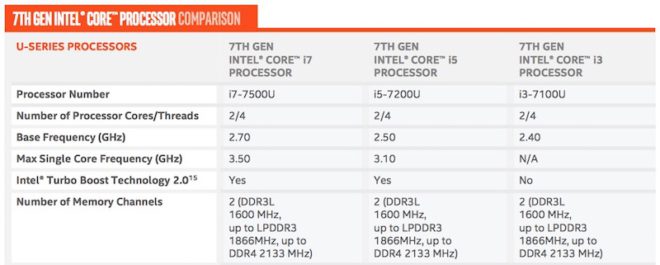
In addition to desktop chips, Intel has also expanded its mobile offering. It introduced H-series processors, which include full-fledged mobile chips with TDPs of 28-35-45W. These are therefore notebook processors with adequate cooling. Many foreign readers are wondering why these processors were supposed to be in the new MacBooks. Pro, and that Apple could have waited a month and a half. The question remains, however, what is the real availability of the new 28W chips with better Iris graphics (newly Iris Plus, compared to Iris [Pro]). Pro I recommend complete information about new processors and architecture this analysis on the Anandtech server.
Gallery


Source: Anandtech