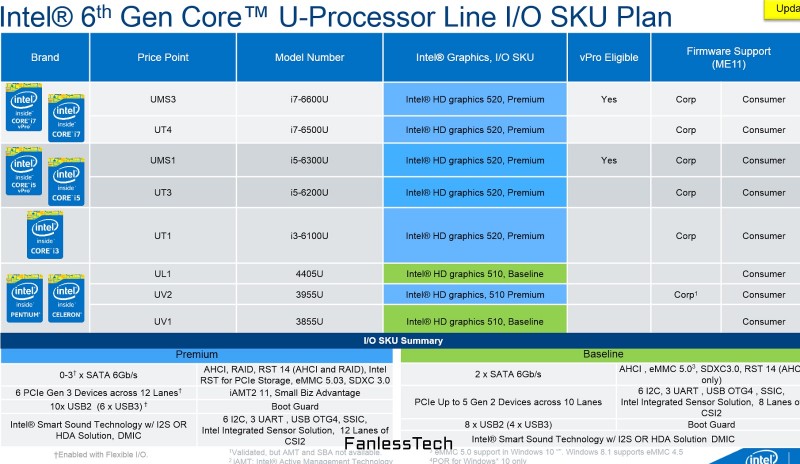
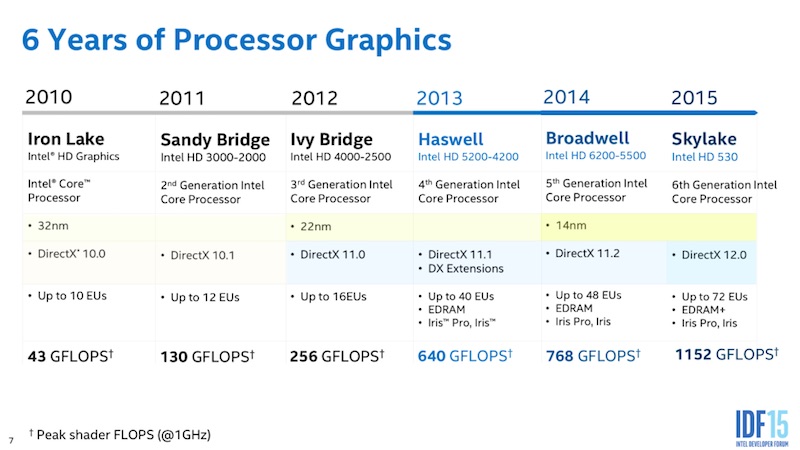
Intel showed the world its new generation of 14-nm Skylake Microarchitecture processors at the IDF14 (Intel Developer Forum) conference held in San Francisku. Skylake Microarchitecture will be the next step in Intel's Tick-Tock strategy, this time it's Tock. Each Tick generation shrinks the process technology and each Tock generation introduces a new architecture. Skylake is based on a 14nm process that will be integrated into new chips for both PCs and mobile devices.
Skylake replaces Broadwell and will be available in the second half of 2015, which is only a few months away from when Broadwell will be available for high-end mobile devices and PCs. The first iteration of Skylake processors will not replace the K-Series SKUs that Broadwell will introduce in Q2 2015, but by being based on a new architecture, Skylake will bring improvements in core performance and better power utilization. It's worth noting that Intel already had models running 3DMark Icetorm on PCs and labtops at the show.
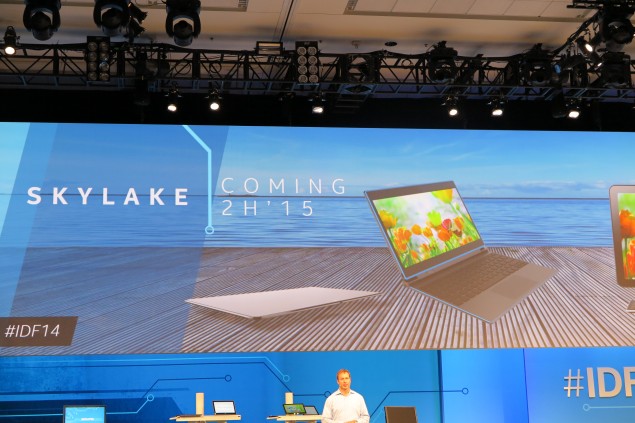
The fact that Skylake will be available in the second half of 2015 is nothing new. It was already clear a few months ago when these processors were introduced, but now Intel has officially confirmed it. The Intel Core-M and Broadwell Y-Series, which will be released on Christmas, are aimed primarily at the tablet and laptop market. ProThe desktop processors won't be available until 2015, which is a bit surprising since that's when Intel will release the Broadwell-K series. The Skylake-S processors will be released at that time or a little later. This release schedule was shown in the presentation.
The move to the Z170 chipset won't be a massive upgrade, and will be similar to the move from Z87 to Z97, which only brought a few new features, such as more PCI-e lanes, Super Speed USB, and up to 10 USB ports, which is quite a bit more than the 6 ports currently available on current boards. In total, there will be six 100-series chipset SKUs, including the Z170 (performance) replacing the Z97, the H170 (power) replacing the H97, the H110 (value) replacing the H81, the B150 (small and medium business) replacing the B85, and the Q170 chipset with Intel in thePro / SIPP, which will replace the Q87 and Q85. As you can see, Intel has a comprehensive replacement plan in place that will update the current desktop chipset available in 2015. Intel will also gradually release their Ivy Bridge-E and Z77/H77/H75/Q75 chipsets in early 2015. This change does not eliminate support for Z97 and Z87 in 2015, as there are still a large number of customers using Broadwell and Haswell processors, as these platforms have longer support and will be discontinued in a few years.
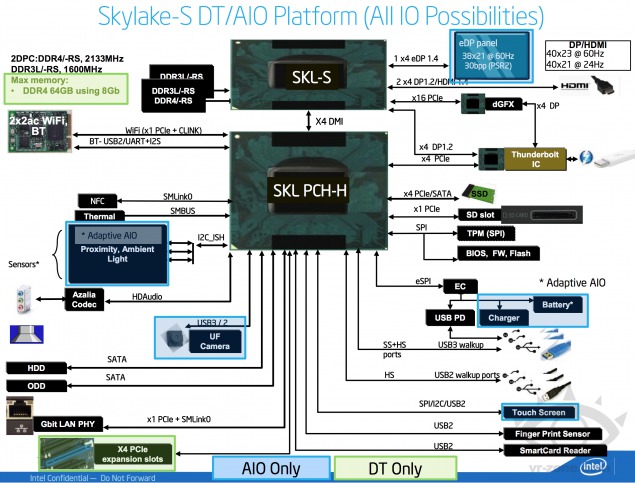
Z170 will be the flagship performance chipset that will support unlocked K-Series Skylake processors. These variaThe chipset will likely be available in early 2015. The chipset will feature up to 20 PCIe Gen 3 ports, 6 SATA Gen 3 ports, 10 USB 3.0 ports, and a total of 14 USB ports (USB 3.0 / USB 2.0), up to 3 SATA Express ports, up to 3 Intel RST PCI-e storage ports, which may include x2 SATA Express ports, or an M.2 SSD port with improved SPI and x4/x8/x16 Gen 3 PCI-Express support from the processor. In addition to these values, we know that Skylake processors will be compatible with the latest LGA 1151 motherboards and with the Z170 chipset, which will be part of the new 100-Series chipset that replaces the 9-Series “Wild Cat” PCH. Another interesting thing is that Skylake processors will have both DDR3 and DDR4 controllers, so different SKUs can be configured for different types of memory.
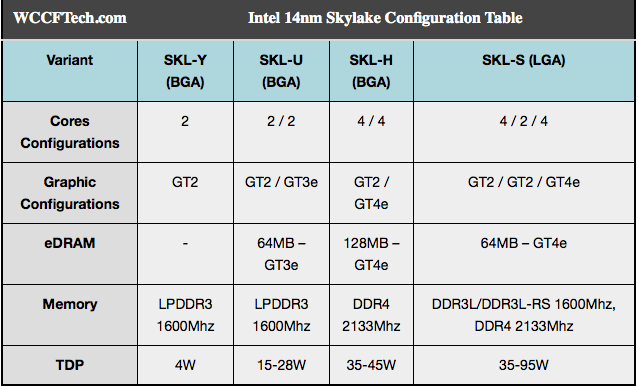
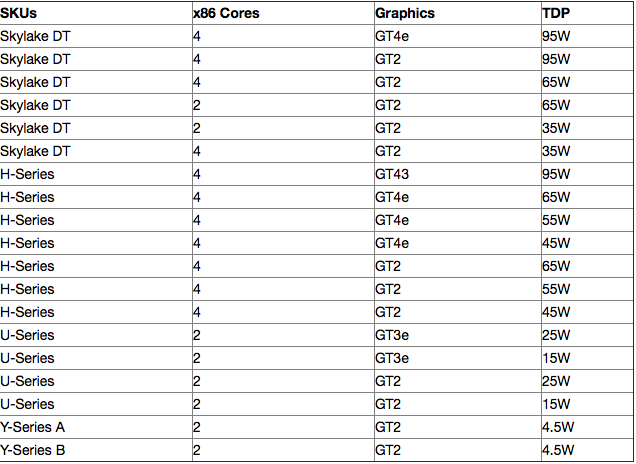
TDPs have also been confirmed for Skylake. As revealed a month ago, the TDPs will include multiple core configurations of the Skylake SKUs. Desktop varianta will also have six different variant, which will feature flagship 95W Quad-Core with GT2 and GT4 GPUs, while the lowest 35W TDP varianta will feature a Dual Core and GT2 graphics. The H-Series will feature a 95W Quad Core with GT4e graphics chip, but it is the only flagship chip, followed by 65W, 55W and 45W Quad Cores varianty with a mix of GT4e and GT2 graphics. Skylake gets rid of the FVIR (Fully Integrated Voltage Regulator), which featured on the Haswell generation of processors and will continue on Broadwell processors in the first half of 2015.
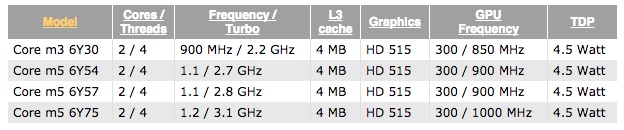
This H-Series will most likely not contain Dual Core at all. The U-Series range will have a TDP of 25W and 15W with the flagship part featuring Dual Cores and GT3e graphics, while the other models have GT2 graphics. The latest Y-Series Skylake lineup has two SKUs, both featuring 4.5W TDP, 2 Cores and GT2 graphics. The difference between them was not mentioned, but most likely it will be a change in timing.
We will also see several new wireless technologies on the 100-Series chip, such as Snowfield Peak (WiFi + Bluetooth) replacing Wilkins Peak and Douglas Peak (WiGig + Wifi + BT) replacing Stone Peak, Maple Peak and Pike Peak plus WWAN LTE chips (XMM 726x) that replace WWAN (XMM7160) for wirelessoneIntel is also introducing the latest Alpine Ridge Thunderbolt controller with Skylake with speeds up to 40GB/s, double the previous generation. Pro Intel LAN introduced Jacksonville replacing Clarksville.
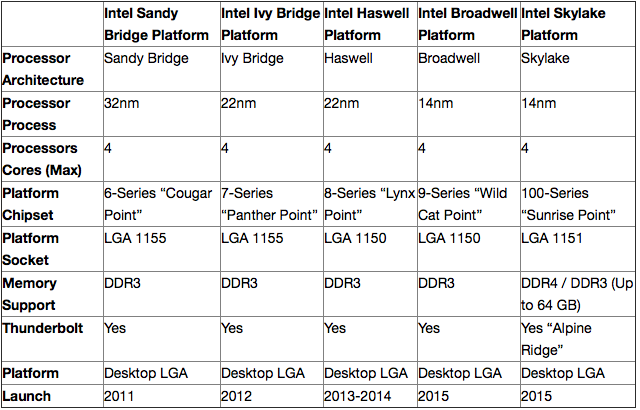
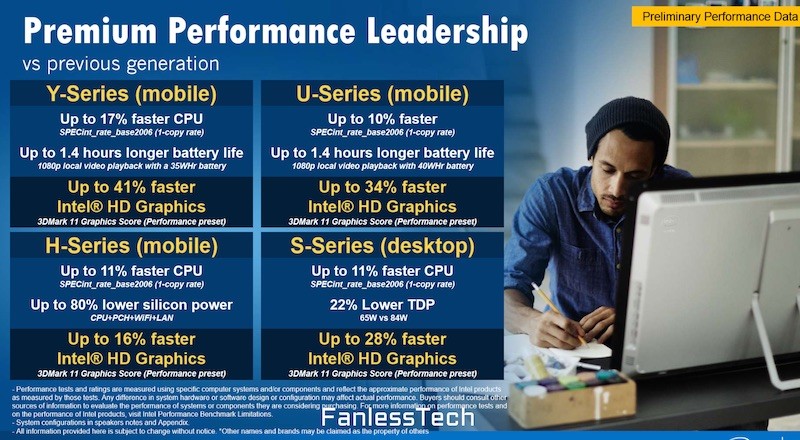
Skylake will be one of the hottest releases of 2015 thanks to its true 14nm processor. Higher IPC and graphics performance combined with an efficient design means that Skylake can be perfect for mainstream users as well as enthusiasts.